
Symposium Keynote Preview: Mitch Epstein and Robert Slifkin Consider Photography as Economy and its Role in Activism
Posted on October 1, 2025
In advance of their FotoFocus Symposium keynote, photographer Mitch Epstein and art historian Robert Slifkin discuss how photography is shaped by economies as well as the paradox between its use as a tool to raise awareness in times of catastrophe rather than taking direct action. This year’s FotoFocus Symposium theme, Photo-Economics, asks us to consider how photography is both an art form and an economy and how it can tow the line between art and activism.
“The thing about economy and photography, they’re utterly intertwined in a complex host of ways, from my perspective.” – Mitch Epstein
Photography As Economy
For Epstein, sustaining a decades-long photography practice comes with its own economic weight. “To have the privilege to sustain a photographic practice, that’s its own economy,” he explained. He continued by saying “the cost of what I do, and how I go about funding my work, and sustaining it in a way that’s realistic and not wasteful” is always a consideration. He described being mindful about materials: “I will go to as many sites as I need to go to, to experience a subject and to have opportunities to respond and engage with it, as my practice dictates it. But with the consciousness of not being wasteful, because I don’t have unlimited means.”
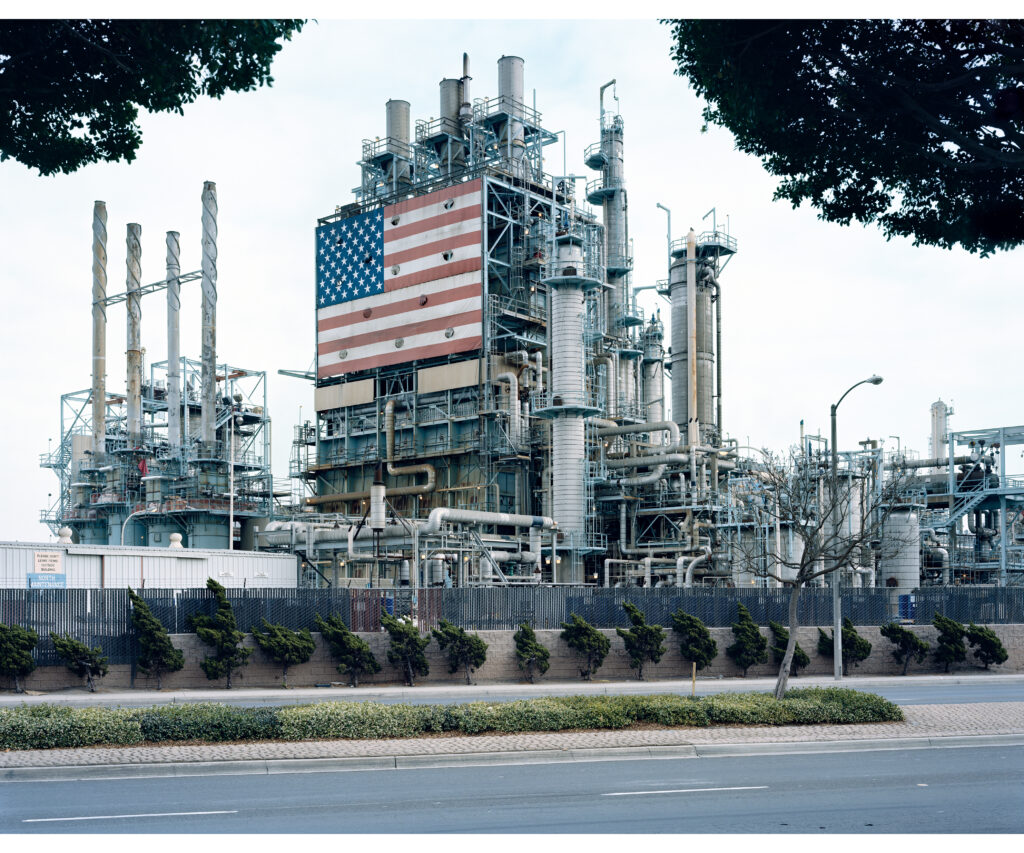
Beyond that, Epstein said he keeps in mind how the themes of the projects he makes relate to multiple kinds of economies. Slifkin agreed. “In terms of Mitch’s practice,” Slifkin stated, “I think it has much more to do with using photography to think about systems of economic power and how they relate to resource extraction in particular, and energy production.”
The economic entanglements extend to land and property, frequent subjects in Epstein’s work. As Slifkin put it: “Another thing that we’re going to be thinking about is how Mitch’s work imagines things that are often increasingly understood in terms of economic value, like property” and “the way that the camera appropriates a subject.” Embodying this tension is Epstein’s recent series, Old Growth, which documents the remnants of untampered forests in the U.S., embodies this tension. “Old growth trees do a lot of the heavy lifting with carbon sequestration,” Epstein said. “We’ve exploited over 95% of them… and so yes, there is a kind of personal political position in mind as I make this work, but I’m not simply at service to that.”


From Economy to Activism
If photography is embedded in economies, can it also resist them? Both Epstein and Slifkin suggest it’s complicated.
For Slifkin, photography as activism is always paradoxical. “By photographing something, you’re not doing something in some ways. You’re photographing the catastrophe rather than engaging in it. Yet, by photographing the catastrophe, you are able to raise consciousness about it.” He sees this as both a strength and a limitation of photography: powerful as representation, but not the same as direct action.
Epstein echoed this tension. “All art can play a part in social activism, but when it becomes single-mindedly, or single-purposefully didactic, and messagistic, it’s no longer art,” he argued. “It’s something else. Which is fine, it’s just that’s not how I see it. I’m coming out of a practice of making art that is multidimensional, and complex, and that’s really better at… asking and framing questions than it is in prescribing answers.”
Questions, Not Answers
Across their perspectives, Slifkin and Epstein return to the idea that photography is not just a simple tool of protest, but a medium that has the ability to frame deeper questions about value, power, and economies. As Slifkin noted, art changes consciousness gradually, while activism demands urgent action. Epstein underscored this point: “There’s no easy formula. It’s very unpredictable when you are fully embodying the uncertainties, and the risk, and the intrinsic failure.” At this year’s Symposium, their keynote conversation will not prescribe solutions to these questions but will open a space to think about photography’s role within economies. It will invite us to consider how photography both participates in economic systems and resists them by creating other forms of value.
Join us at the FotoFocus Symposium on October 4, 2025, to hear more from Mitch Epstein and Robert Slifkin as well as additional conversations related to Photo-Economics and the ways images shape, and are shaped by, the world’s economies.