
Big Tent Artist Interviews
Posted on July 16, 2026
Several artists from Big Tent were asked a series of questions about their work(s) included in the exhibition. Learn more about selected works by Madeleine Hordinski, Alyse Emdur, Marco Anelli, Melvin Grier, David Benjamin Sherry, Stacy Krantiz, and Asa Featherstone IV in the artist interviews below.
Tell us about your work(s) in Big Tent. When was it taken and what does it symbolize?
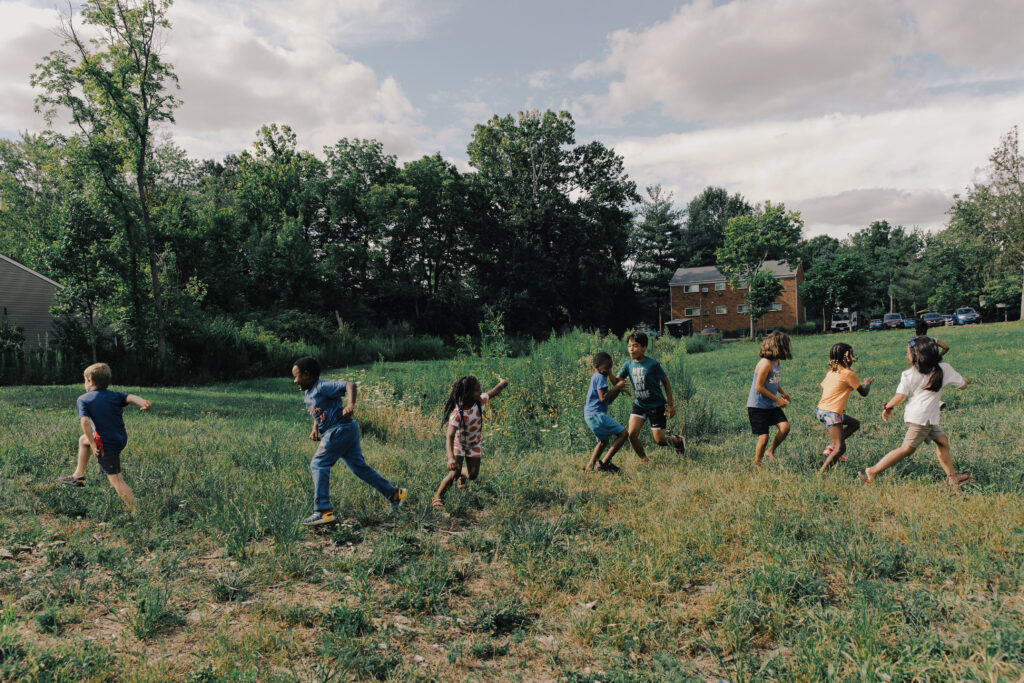
Madeleine Hordinski: Midwestern Magic is an image I made on assignment for the New York Times in 2024. I was asked to create photographs that define the Midwest, and the photo editor gave me freedom to interpret the assignment, so I focused on downtown Cincinnati and its suburbs. I kept asking myself: how do I capture what the Midwest feels like, and what it means to live here? More specifically, how do I convey Cincinnati’s spirit? I spent a lot of time driving around, searching for images that felt true to my home. Of everything I photographed, this is my favorite. It reminds me of growing up here, and of what makes the Midwest so special.
Dion Green is an image I made on assignment for the Guardian, for a story about Dion, a survivor of a mass shooting in Dayton who helped file a lawsuit against the gun industry after the shooting took his father’s life along with eight others. Dion is one of millions of Americans whose lives have been forever altered by gun violence. His story is also a story about what comes after: grief, resilience, and the fight against the systems that perpetuate it.

Alyse Emdur: The photograph I contributed, Brisio Pintor, is from my 2013 book Prison Landscapes — a collection of portraits of incarcerated people, posed in front of hand-painted backdrops in prison visiting rooms: tropical beaches, waterfalls, mountain vistas, and other scenes that represent freedom.
Marco Anelli: The five portraits in Big Tent are part of my ongoing project First American Portrait, which I started in 2018 after attending my first naturalization ceremony in New York. Since then, I have photographed more than forty ceremonies across the United States, portraying new citizens from over one hundred countries.
A naturalization ceremony is the last step in becoming an American citizen. It is an official moment, but also a very emotional one. I was interested in meeting people just after the ceremony, when the long process is finally over and something new is beginning.
For me, the project is about that transition. The portraits are made between one chapter and another, between different lives, identities, and sometimes languages. They mark the moment when a very personal journey becomes part of the larger story of America.
Melvin Grier: I had a career as a staff photographer for The Cincinnati Post, an afternoon daily newspaper owned by Scripps Howard, and also had a Kentucky Post edition.The photograph that I have in Big Tent is just one of many encounters I made and photographed during my 33 year career. I found the three young people walking past my parked vehicle wearing t-shirts fashioned into head and face covering and thought they offered potential for a good photo. There was no symbolism other than the possibility of an interesting image.
David Benjamin Sherry: This photograph was taken at White Sands, New Mexico, in July 2015. It’s from a larger body of work titled Paradise Fire. For me, it symbolizes many things, but primarily the visibility of LGBTQ people within National Parks and outdoor spaces.
There’s another layer to the work as well. White Sands National Park is the site of the world’s first nuclear test, while also being home to Indigenous communities for more than 23,000 years. It contains the oldest known human footprints in North America and remains deeply significant, both culturally and spiritually, to regional tribes.
Stacy Kranitz: July 04, 2015
Letart is a small community on the Ohio River that has been impacted by PFOA (C-8 / Forever Chemical) pollution of its water supply due to its proximity to the Dupont Washington Works plant in Parkersburg, West Virginia where Forever Chemicals were produced beginning in the 1950s and continuing for decades—well into the early 2000s. A DuPont waste disposal site is located in Letart and is known as the Letart Landfill. Groundwater monitoring around the Letart Landfill has detected the presence of C8, indicating that the chemical has migrated from the landfill into local water sources.
Asa Featherstone IV: Both photographs are from a series called Interludes, created in 2023.
Màggal follows a Senegalese man living in the United States with his family. The balloons symbolize celebration, hope, and opportunity, but they also point to a question I’ve been thinking about for a long time: Do Black and Brown people always have to be advocates, or are we allowed to simply rest? The image lives in that tension between joy and responsibility.
The Gift shows the exchange of a wildflower between two people. Their relationship is intentionally left open to interpretation. The flower could represent love, trust, agreement, generosity, or something else entirely. I wanted viewers to bring their own experiences to the image.
What made this particular image or series feel important to include in Big Tent?
MH: Although these two images were made for very different stories, they both speak to familiar threads of what it means to be American: joy and beauty on one hand, loss and resilience on the other. Together they reflect the range of experiences that exist all at once in our country.

AE: Brisio Pintor is an American who was incarcerated at the Preston E. Smith Unit in Lamesa, TX. His portrait was made by an unknown incarcerated photographer. When thinking about our democracy as a “Big Tent,” I think it’s important to include marginalized Americans like Brisio Pintor.
MA: What I find compelling about Big Tent is its interest in the many experiences, backgrounds, and perspectives that coexist within American society.
Immigration is often spoken about in abstract or impersonal terms, or through numbers, policies, and categories. With First American Portrait, I wanted to bring attention back to the individual person.
For me, the series connects with Big Tent because it brings together many different personal stories. Each portrait belongs to one person and one moment, but seen together they begin to suggest a wider image of America.
MG: I have any number of photos that I think would be suitable for Big Tent, someone other than myself chose this particular photo “Urban Ninja.”
DBS: I think this portrait adds to the broader story of American life that Big Tent is trying to tell. It expands the idea of who belongs in the American landscape and whose stories deserve to be seen within it.
SK: I was glad that the work had a direct connection to Cincinnati through the Ohio River. I value any opportunity that allows me to bring rural issues to urban communities.

AF: When I think about Big Tent, I think about making room for people to belong.
Both images focus on quiet moments that are easy to overlook. The Gift celebrates gentleness and connection at a time when we’re often told that change only comes through big, dramatic action. Màggal reminds us that joy and celebration can exist alongside struggle.
Together, they create space for rest, care, and humanity, which feels very much in line with what Big Tent represents to me.
Is there something about this piece that viewers might overlook?
MH: I’m actually more curious about what viewers will notice that I haven’t.
AE: Viewers might not realize that I didn’t take this photograph myself. It was made by an incarcerated volunteer photographer, within a visiting-room system that dictates exactly what can and can’t be in the frame — prisoners are instructed not to photograph anything beyond the edges of the painted backdrop. So what looks like a portrait is actually the product of a tightly controlled system of self-representation: the prison permits the image, crops its boundaries, and profits from it, while the subject finds a way to represent themselves within those confines. The portraits also point to the collateral damage of our prison system — the mothers, wives, and children who receive them to remember their loved ones while they are locked up.

MA: The portrait sessions are very brief, often just a few minutes long. I usually choose the location and the background depending on the situation, but after that I try to keep the moment very simple.
I don’t direct people too much. I prefer to let them be themselves in front of the camera. Sometimes, at the beginning, people smile because smiling is almost a kind of mask we naturally wear in front of the camera. After a little while, I may ask them to let the smile go for a moment, not to look serious, but just to be more themselves.
Often, that is when the portrait changes. Something more quiet and direct can appear. Some people hold their certificate, a flag, or flowers; some stand with family members; others are alone. Some wear traditional clothes from their country of origin, while others include small details from the American flag. What interests me are these small details and natural choices, because they show how each person relates to the ceremony in a very personal way.
MG: It is my experience that the viewers tend to see different things when viewing my work. I think that is a good thing.
DBS: That’s a hard question because I like to think viewers bring their own experiences to a photograph. I’m not especially interested in telling people how they should interpret the work.
What they might overlook is that I see a version of my younger self in Tess. When I was their age, I wasn’t nearly as confident or proud of my identity because the world was very different in the 1980s and ’90s. When I made this photograph, it still felt unusual to see openly queer people represented in National Parks. That changed in many ways, although it also feels like we’ve regressed again in the last few years. In some ways, the photograph feels even more relevant today, as queer and trans people continue to face increasing hostility while our country has grown more politically divided, conservative and more openly anti-LGBTQ.

SK: I think it is easy to overlook the environmental concerns lurking beneath the water in our daily life and in this photograph.
AF: I hope people spend time with the details.
In The Gift, the hands tell their own story. The wrinkles, rings, skin tones, and gestures all reveal little clues about a person’s life and experiences. Hands can tell stories about labor, age, care, relationships, and experience. It’s easy to look at the flower, but I’m just as interested in the people holding it.
With Màggal, I hope viewers notice the expressions. Neither photograph is in a hurry, asking for immediate attention. It’s a quiet image. The longer you sit with it, the more you notice the expression, posture, and small details that make the subject feel human and familiar.
Did the work of another artist or series inform your approach to this piece?
MH: While making Midwestern Magic, I remember thinking the scene reminded me of Justine Kurland’s photographs. I admire her work, and she was very much on my mind as I photographed this assignment.
AE: At the time, I was looking at artists who visualize American institutions and try to see the unseen — Frederick Wiseman, Taryn Simon, and Trevor Paglen. Because of the initial difficulty of gaining access to photographs inside prisons, I became pen pals with hundreds of incarcerated Americans, and built the project around prisoner-made, prison-approved vernacular photography. I was also moved by German photographers like Bernd and Hilla Becher and August Sander. Like Sander, I’m interested in subjects as data points to visualize a system. But my work is also humanistic. I am awed by how people survive in inhuman environments.
MA: More than one specific artist or series, my approach comes from a long interest in portraiture and in what photography can and cannot reveal.
I think photography always contains a paradox. On one hand, it has a strong documentary authority, and we tend to believe photographs. But at the same time, a photograph is radically incomplete and never fully explains a person.
That limit is important to me. I am not trying to define someone’s identity through a portrait. I am more interested in describing a moment in which something about that person becomes visible, even briefly.

DBS: I’ve always admired the portraits of Joel Sternfeld and Walker Evans. Most of my own work is centered on landscape, so making a portrait always feels special to me. A person really has to stand out for me to make that kind of photograph.
SK: The entire history of photography plays an important role in how I conceive of my work and make it, particularly the documentary tradition.
AF: I’m constantly inspired by my family, especially my grandfather, who was a painter. His work made bold use of color, particularly rich yellows and blues. That sensitivity to color has stayed with me and finds its way into my photography. In these images, especially, the warmth of the yellow tones can be traced back to that influence.
I’m also inspired by photographer Aundre Larrow. His portraits feel deeply lived-in, as though you’re sharing space with the subject rather than simply observing them. I admire the quietness of his work and the way he allows small details to carry emotional weight. There is often very little action in his photographs, which encourages viewers to linger and discover meaning over time. That’s an approach I aspire to in my own work, and one that shaped both of these images.
What does the phrase Big Tent mean to you?
MH: To me, “Big Tent” means that being American can look and feel like so many different things — different histories, different struggles, different joys. And yet, more often than not, we have more in common with the stranger next to us than we realize.
AE: To me, “Big Tent” means America is big enough for everyone — that our ship is not full. The country was founded by immigrants, and it’s our diversity that makes America, America.
MA: To me, “Big Tent” suggests a space large enough to contain many different stories without forcing them into a single narrative.
That idea feels very close to my experience photographing naturalization ceremonies. People arrive from different countries, cultures, religions, languages, and personal histories, yet for a brief moment they participate in the same ceremony and share the same sense of anticipation.
The project showed me that belonging does not require sameness. A democratic society can create a shared space while preserving difference, and that is what the phrase “Big Tent” evokes for me.
MG: “Big Tent” means a wider acceptance of work from various photographers and zip codes. I have been an advocate for the inclusion of local and regional photographers in FotoFocus Biennials.
DBS: Honestly, I think of a circus—which, in many ways, feels like a fitting metaphor for American life.
SK: For me, the phrase represents inclusivity and tolerance of differing ideas and viewpoints that make up American society.
AF: To me, “Big Tent” feels like a giant hug.
When I think about a tent, I think about shelter, community, and memories. It’s a place where people gather, share experiences, and create memories together. There’s comfort in that.
What I love about the title is that it suggests there’s room for everyone. Different backgrounds, different perspectives, different stories—all existing without requiring everyone to be the same.
Do you see your work as political, civic, personal, or some combination of those?
MH: My work is deeply personal; I draw on my own life and experiences every time I make a picture. What I love most about photography is that it offers a window into someone else’s world, and a photograph is one small chance to glimpse it.
AE: My work is both personal and political. Prison Landscapes began when I found a photograph of myself at age five with my brother Bruce, in the visiting room at Bayside State Prison in Leesburg, NJ.
I don’t consider my work activist art. When I think of activist photography, I think of someone like Ansel Adams, who in 1938 published photographs of the Kings Canyon area specifically to lobby Congress for its protection as a national park. It’s important to me not to reveal a clear political viewpoint in my own work — I’m interested in work that’s complex and has multiple points of entry, and I have no interest in telling people how to think or what to do.
That said, Prison Landscapes created a place for its participants to be seen. The project gave incarcerated Americans the chance to represent themselves to a large audience. I think a lot about the act of being seen in intimate relationships — parental, romantic, friendships. Being seen and understood is, I think, one of the deepest forms of love. The same holds true in the public sphere: we have an innate need to be seen. For people who are incarcerated — literally hidden behind brick walls and barbed wire, often in rural areas far from any town — the chance to be seen is even more vital. Many of the people I corresponded with over the years spoke about feeling invisible and forgotten. Being part of something outside the prison, and being seen by people who would never otherwise know they existed, mattered enormously to them.

MA: I see this project as personal, but not political in intention.
My intention was not to make a political statement about immigration. Having gone through the naturalization process myself, I felt close to that moment, but I also knew that each person’s story was completely different. I was interested in meeting people at a very specific and important point in their lives, immediately after becoming American citizens.
Being an outsider is probably important to the work. Distance brings attention, and sometimes an outsider notices things that may become invisible to people inside a culture. In my relationship with the subjects, there is both distance and identification.
Through these portraits, I am not trying to present a complete idea of America. I am trying to encounter people one by one, and to give a human face to a subject that is often discussed in abstract terms.
MG: A great deal of my photographs came from assignments that The Post sent me on, so there were some with political overtones, of course. I covered the citizens of Cincinnati, other cities and towns, and even trips out of the USA.
DBS: I do. I was raised by two moms (and a dad), and much of my childhood felt like a challenge to the norms of American life. Growing up with queer parents in the 1980s and ’90s was very isolating, especially during the AIDS crisis. I watched many of my moms’ friends die from AIDS,
s a young boy I grew terrified. I genuinely believed that if I ever admitted I was gay, I would somehow die from AIDS too.
Because of that, my life has always been political. My experiences shaped who I am, and they inevitably shape my art.
My work focuses on the environment, preservation, and identity within the context of landscape, particularly in the American West. I think of my practice as part of “queering the landscape.” Historically, landscape photography has been framed as a rugged, masculine genre, and growing up I had no queer role models working in that space. I wanted to create work that showed there was room for people like me within that tradition, and hopefully make it easier for others to see themselves there as well.
As a gay person, my existence is inherently political, and because my work is an extension of my life—and in many ways my soul practice—it is inherently political too. Sometimes that politics is subtle, and other times it’s explicit. My 2019 project American Monuments, for example, documented National Monuments that were targeted during the Trump administration for reduction or elimination for natural resource development. These are some of our country’s most extraordinary landscapes—places that are ecologically, historically, culturally, and spiritually significant, particularly to Indigenous communities. Some of these places have single handedly given me the space to grief, love, grow and understand who I am. The project became a way of bearing witness to what was at stake, while also asking who our public lands belong to and whose histories they preserve.
SK: I see my work as political, aesthetic, and conceptual. It is the different ways these elements interact that interests me.
AF: A combination of all three.
Much of my work centers on the idea of belonging. Right now, that feels especially important. We spend so much time talking about who belongs and who doesn’t, but true belonging shouldn’t be something people have to earn. True belonging is passive. It’s the feeling of being welcomed without explanation, of knowing that your presence is enough.
I’m interested in creating images that allow people to simply exist—to be seen, cared for, and at home. Even rest and stillness can feel countercultural in a society that constantly asks us to produce, perform, and prove ourselves.