Featured Exhibition Highlight: Natural Fictions
Posted on September 18, 2026
One of six Featured Exhibitions in the 2026 Biennial, Natural Fictions is co-curated by Lindsay Albert, Program Manager at KADIST, and Sso-Rha Kang, Curator at The Carnegie. The 2026 Biennial Opening Program will kick off at The Carnegie on Wednesday, September 30 for the Opening Reception. Additionally, Albert will moderate a conversation between artists Joshua Berg, Covington, KY; Heesoo Kwon, Los Angeles, CA; and Phillip Maisel, San Francisco, CA on Saturday, October 3, 1pm. These events are open to anyone with the free Biennial Pass.
Natural Fictions considers how photography can resist linearity and certainty. What new narratives emerge when nature is approached as something invented as much as it is observed? What futures might become imaginable when science meets spirit or when perspective is shaped by play instead of conquest? Natural Fictions invites viewers to look sideways—and forward—at the environments we inhabit, inherit, and imagine.
Sso-Rha Kang and Lindsay Albert discussed the exhibition, how it came to be, and how it evolved throughout the process. Read their conversation below.

Sso-Rha Kang: Hello, Lindsay.
Lindsay Albert: Hello, Sso-Rha.
SK: I want to give a little context on how our collaboration started. I was the curator in residence at KADIST and did a site visit to San Francisco last February, where you arranged a series of studio visits for me. I feel like that just naturally lent itself for us to collaborate on the show for FotoFocus, and I invited you to be a part of our visiting curator program.
I wanted to ask you, why did you choose the title, Natural Fictions, and how do you think it pertains to this year’s theme, The Long View?
LA: Great question. So each artist in this show is really conjuring their own landscape. It’s layered with time, memory, and myth, and through that landscape becomes this site of experimentation and wonder where imagined futures and forgotten past can sit together in this pretty surreal and poetic way. And that’s where Natural Fictions comes from. These aren’t documentary landscapes; they’re invented ones.
And The Long View is really about time and perspective in photography and film—how those mediums shape the way we understand the world. So Natural Fictions takes that same idea and turns it toward landscape specifically. If photography already bends time, what happens when the land itself becomes part of the fiction? That’s where I was going with the theme and the title.
SK: Yeah. I feel like we saw some of those themes already occurring when I did my site visit with you. In exchange, and as a part of our visiting curator program, I invited you to do studio visits in both Kentucky and Ohio. We did a lot of studio visits, but what in particular drew you to the works from Josh, Lydia, and Ruby?
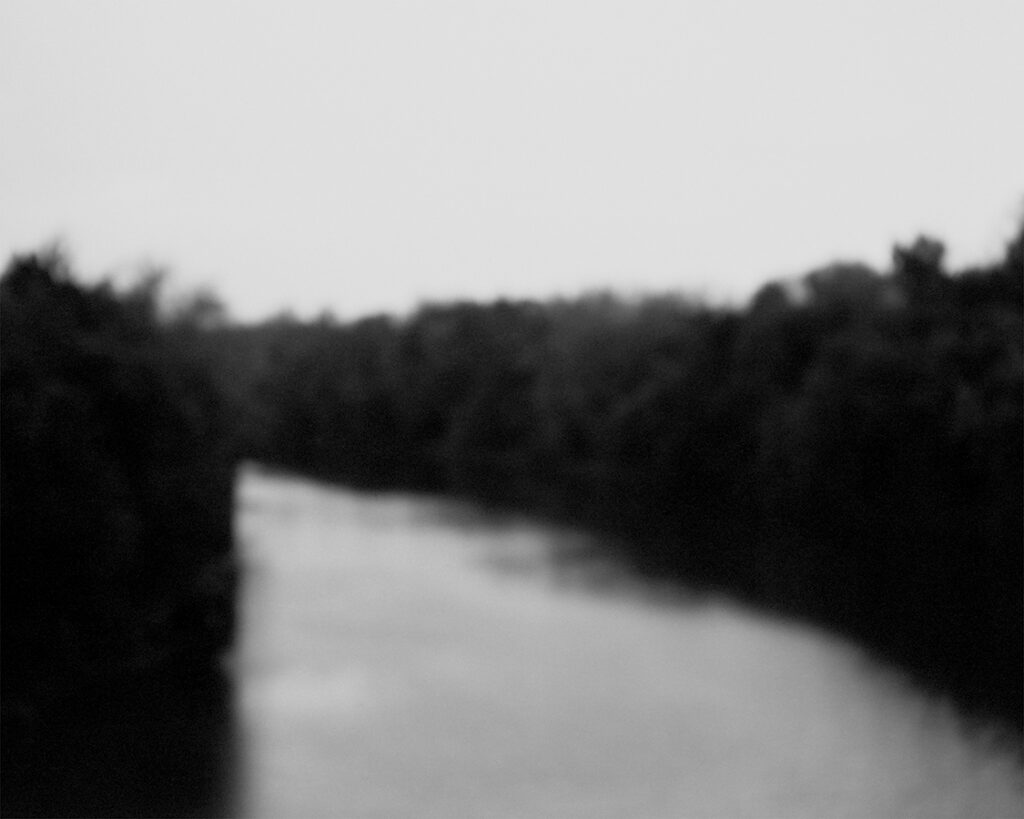
LA: Well, Josh was one of the first ones that we did. And with his work, I felt like there was something mysterious about his imagery and was really drawn to the ritualistic return he has, going back again and again to the same rivers, the Ohio and the Licking, and to that same landscape. I found that extremely fascinating.
And then with Lydia, when we did the studio visit with her, the cyclorama of the Norwood Mound is what first pulled me in—that scale, applied to a site we actually know almost nothing about, really. And getting to know the work meant getting to know how she thinks. She has this way of defining place that I still think about: And I’m going to quote her because I really remembered that from our virtual studio visit, which was really nice. “Place has a center, a pinpoint within this vastness of a landscape, how space is marked by time and made knowing by memory.” That comes out of her own research on cemeteries, and these earthworks in the region—so few remain, which is also fascinating; there’s no living memory of how they were actually used, and that mystery is exactly what her piece holds.
So thinking about Josh and Lydia, I noticed the kinship between them pretty quickly—the obvious thing is they’re working in the same region, but underneath that, they share a sense of landscape as mystery, space marked by time, made known by memory.
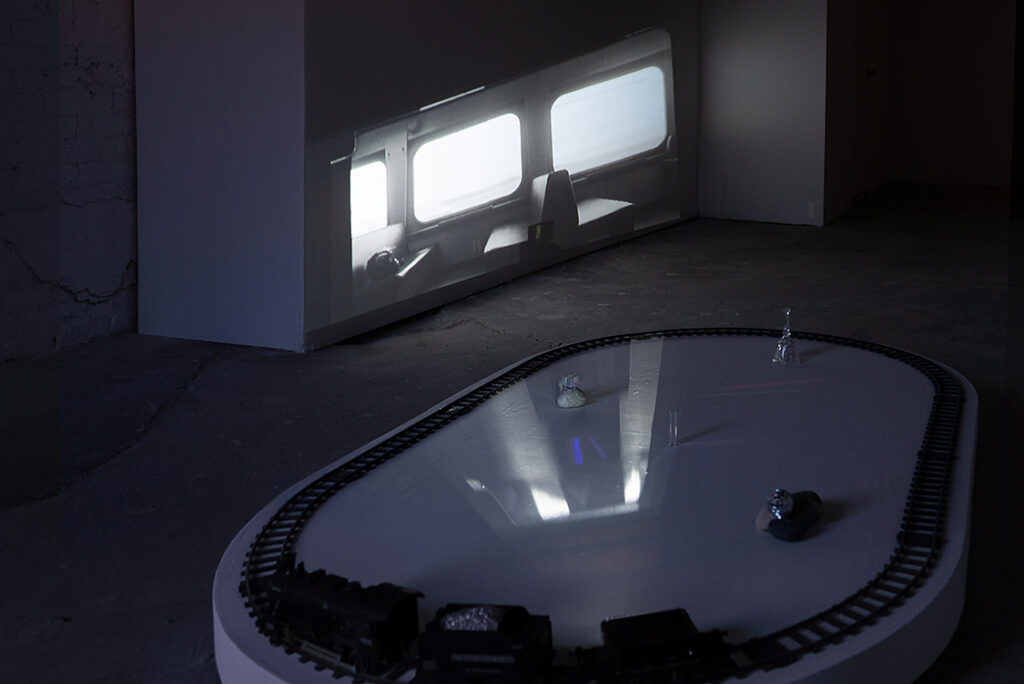
And then lastly with Ruby, I mean, you introduced me to Ruby, and you shared their work with me. I think we both really gravitated towards the Travelogue piece. I was thinking a little bit more about that piece with the train and the projector on top of the train. It’s projecting these images that they have taken of an empty landscape, treating travel—not as arrival, but as its own suspended state. It’s a surreal rumination on what it feels like to move through an unfamiliar landscape where travel becomes almost a form of displacement.
So with those three, I just think it’s really fascinating how they’re all utilizing landscape as place.
SK: And thinking about place, I feel like we can’t not talk about the Carnegie’s architecture. I think it’s both unique in the sense that it used to be an old library and it has its own sets of challenges, not just in terms of scale because we have six gallery spaces on two floors that we need to fill, but it also has all these very ornate details. I think you introduced me to Heesoo Kwon’s work when I did my site visit, and then we subsequently ended up collaborating at Headlands, which is also a very ghostly space.
So it was very natural to have her incorporated into this exhibition, where we’ve made some interesting moves where we’re not just displaying work in the gallery space itself, but we’re also activating spaces like the stairwell, for example. When you did your initial site visit, and you saw the Carnegie for the first time, were there any artists that immediately came to mind?
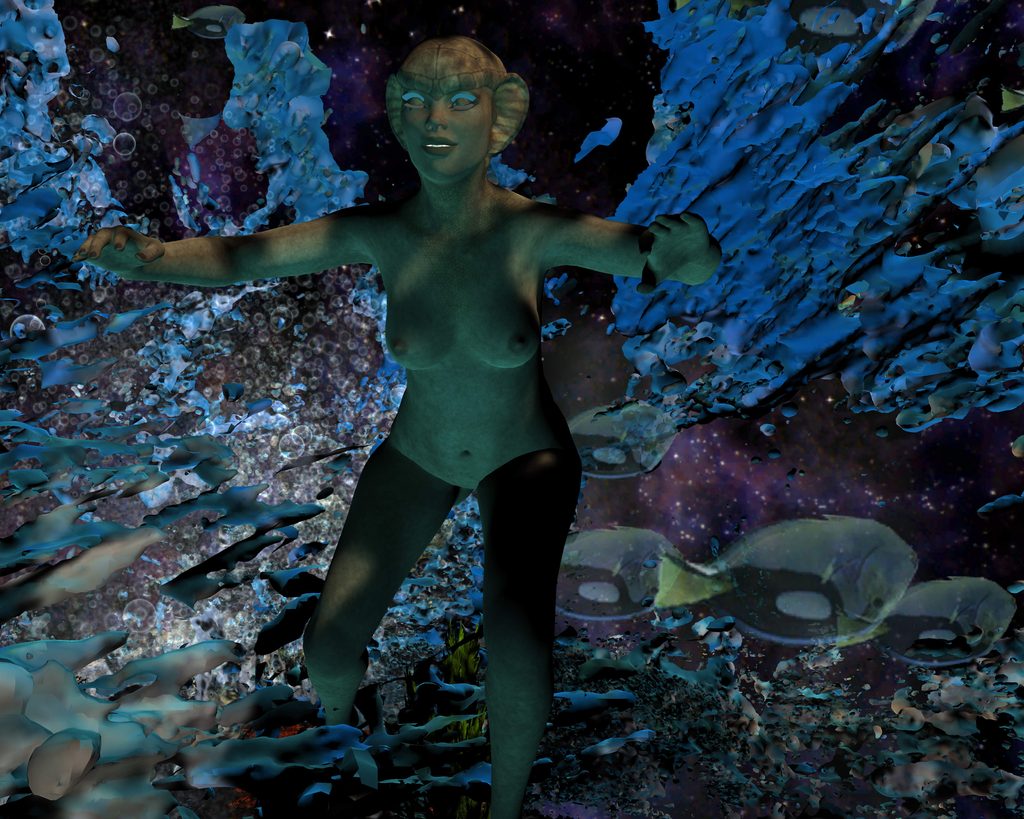
LA: Heesoo Kwon, right away. Right before my site visit, I’d seen images from Shadow Self, a show she did in Amsterdam, and I was struck by how she used that architecture—really ornate—and neither the building nor the work ever overpowered the other. There was this real kinship, this balance. So I could already picture what she’d do with the Carnegie’s weirder spaces, especially the stairwells.
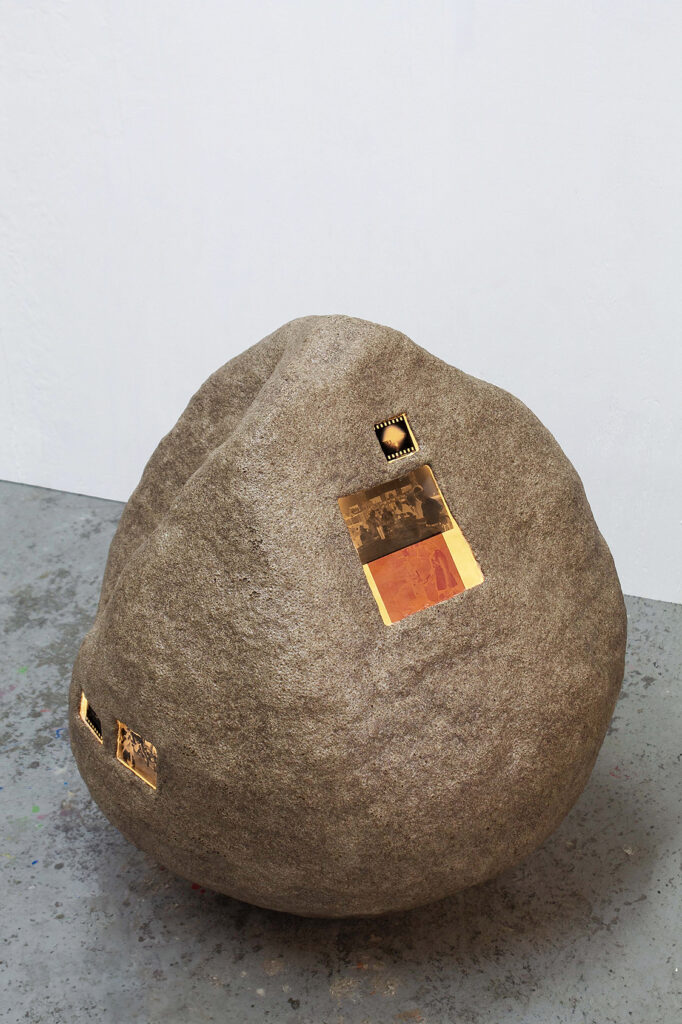
Another artist that came to mind during my visit was Mareiwa Miller. She makes these gorgeous rock sculptures with illuminated found photographs embedded in them. And the Carnegie’s such a big space, I thought, this is the moment to commission something larger, something site-specific from her.
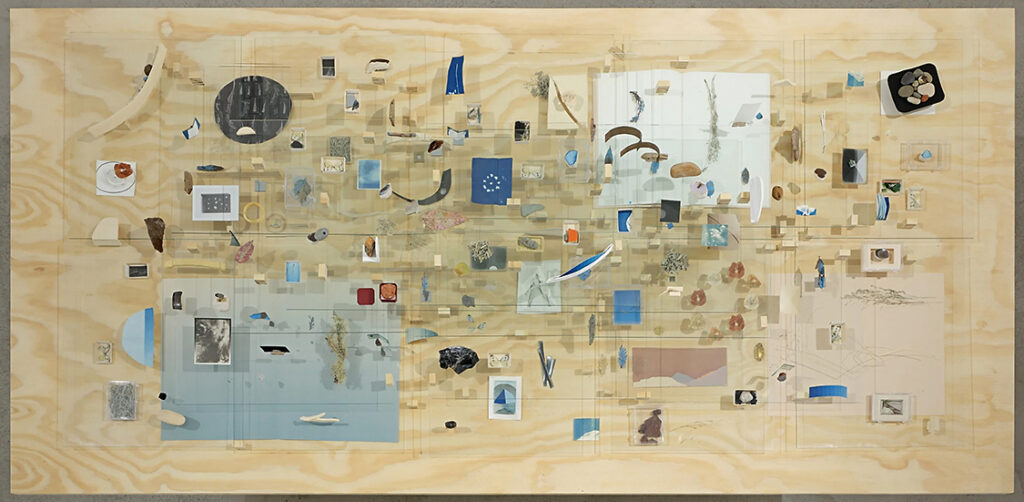
And then lastly, Sean McFarland’s table piece, all these photographic little objects that sit on this table. I think we talked about this; originally, we pictured it downstairs under the rotunda, but once it was actually in the building, it was obvious it needed to be upstairs in the Rieveschl Gallery with that natural light. The light’s really inherent to the piece. It hits the glass, it hits the objects, the whole thing starts to feel three-dimensional.
So those were the three artists that I was thinking about during my site visit.
SK: Yeah, and I mean, I love this exchange that we have between the Midwest/South and the Bay Area, which came about so organically between you and I meeting each other, exchanging our artist lists and getting excited about so many of the same things. I feel the way that we look at art and how we approach it, and maybe our curatorial sensibilities are extremely aligned. I feel like we can’t also not talk about place because our institution is right alongside the Ohio River, and we serve both Kentucky and Ohio communities.
I think being by that body of water is so unique. And my project with KADIST was all about highlighting the Ohio River, so I feel like you’ve been with me on that journey of really exploring that subject matter. So thinking about the Ohio River/Bay connection, there are bodies of water strongly associated with both of our regions. What connections do you see between the Bay Area artists and some of the artists that you’ve done studio visits with in the Midwest and South.
LA Honestly—place, Sso-Rha. That’s the throughline. Every artist in the show, no matter where they’re from, is working with place—how it holds memory, how it’s marked by time, how it refuses to just be a backdrop. In different ways, they’re all blurring the boundary between time and space. Different landscapes, same questions.
SK: Going back to our curatorial sensibilities being really aligned, because a lot of our decisions came about quite organically.
LA: So easy.
SK: When we’re thinking about FotoFocus and specifically lens-based work, I think immediately you and I are very drawn to more interdisciplinary approaches to what we consider lens-based work. And Mareiwa Miller is someone that immediately comes to mind. I mean, I love her ceramic rocks with the photographs that are embedded onto its surfaces. I think the way we’ve curated works into the show is extremely cohesive.
And one of the themes that came out, that was unexpected, was that there are a lot of circular or cyclical themes, whether it was conceptual or quite literal. With those themes that started to unveil itself as we were building the object list, we started to make much more intentional curatorial decisions around them. What are some of your favorite connections that you saw between the works that started to come out as we assembled the object list?
LA: Yeah, that was really fascinating to me, too, as we were identifying the checklist for the show, how we both were like, “Well, there’s a lot of circular themes really taking the lead here.” But I think one of my favorite connections is in the upstairs gallery, the Duveneck Gallery, and it’s Phillip Maisel’s video, Seeing Is and Is Not Believing, which is a man jogging in a loop on a rooftop in Barcelona. That piece is in conversation with Ruby Que’s Travelogue, which is a train that’s not heading toward a destination, just toward more rail, in its own loop. Both pieces are grappling with absence, and both find a strange kind of belonging in transit instead of arrival. That connection, I just really think, is quite poetic and beautiful in that way.
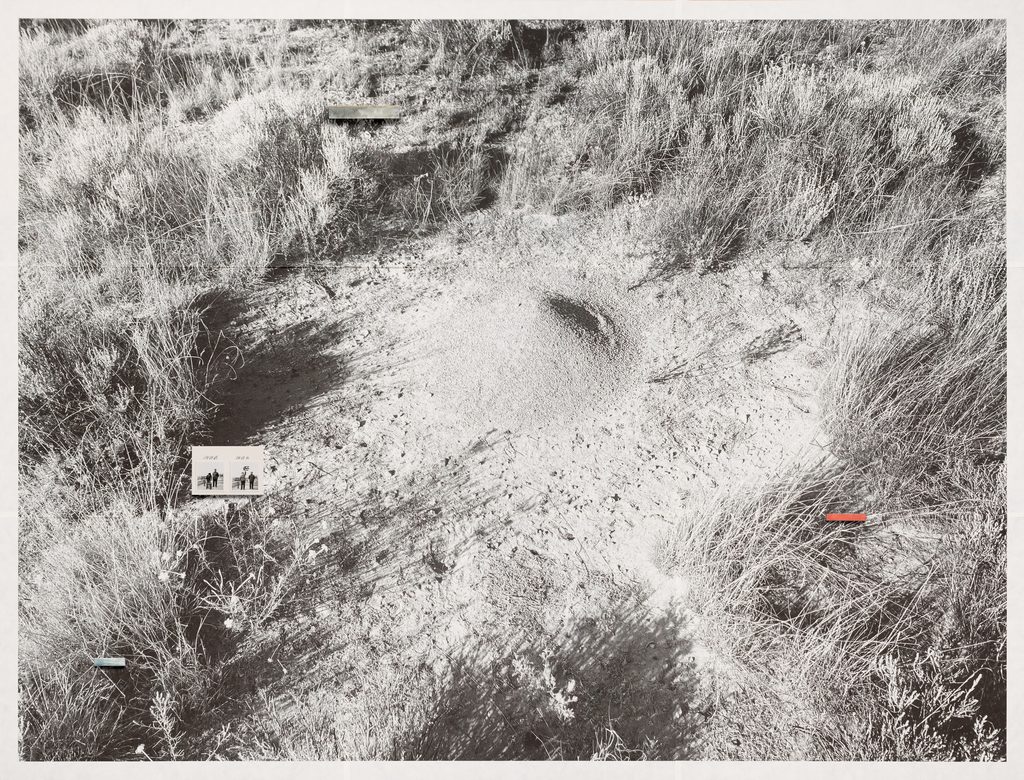
Another one I love is between Lydia’s cyclorama and Phillip’s ant hill photographs—an earthwork we have no living memory of, an ant colony working to its own clock. They’re not asking you to notice how strange that pairing is; they’re asking you to notice how alike they actually are: both structures built on a timescale and by an intelligence that isn’t ours. In both places we can’t fully know the why of. That’s Natural Fictions in miniature, really—two real, natural structures, and a story of connection between them that we’re inventing because the why was never ours to know.
SK: Yeah, and I love that all of this also ties to the rotunda that we have.
LA: Yeah.
SK: Lydia’s Cyclorama is … I know she was taking measurements of the, I don’t know … do you call it the circumference or the diameter of the rotunda?
LA: I think it’s a circumference.
SK: Yeah, so responding to space site-specifically like that. And we made the decision to have one of Phil’s anthills wheat pasted outside of the Carnegie as well. Heesoo’s work activating the stairwell, it’s all very cyclical in this sense.
That’s all the questions that I have. Thank you so much for answering.
LA: Thank you. Thank you. I mean, it was a pleasure. I knew that we were destined to work together again when we met at KADIST, and we both were like, “Katinka Bock.”
About Natural Fictions
September 30, 2026–March 6, 2027
In an age marked by accelerated change and ecological instability, Natural Fictions proposes a slower, stranger, and more speculative gaze. The exhibition gathers artists who harness photography’s potential to imagine new relationships with the natural world—ones that are not bound by documentary fidelity but instead embrace transformation, fiction, and play. Through their work, the landscape becomes a site of experimentation and wonder, where speculative futures and unseen pasts coexist in surreal, poetic, and scientific inquiry.
The artists in this exhibition use the lens not merely to capture the world as it is, but to destabilize it. They fold time, alter perspective, and merge disciplines, constructing images that evoke geological duration, cosmic scale, and embodied mythologies. Some simulate environments that never existed, while others render familiar terrain uncanny through shifts in material, scale, or cultural reference. Their practices explore the camera as both a tool and collaborator in seeing beyond the visible and the known.
Natural Fictions considers how photography can resist linearity and certainty. What new narratives emerge when nature is approached as something invented as much as it is observed? What futures might become imaginable when science meets spirit or when perspective is shaped by play instead of conquest? Natural Fictions invites viewers to look sideways—and forward—at the environments we inhabit, inherit, and imagine.
Related Events
Natural Fictions Opening Reception
September 30, 2026, 5–8pm
Artist Talks and Keynote Lecture
October 3, 2026, 12–6pm
Lydia Smith: Artist Talk on Cyclorama (Norwood Mound)
December 5, 2026, 12–1:30pm
Exhibition Photo Walk
February 13, 2027, 12–1:30pm