Chip Thomas Named 2026 MacArthur Fellow
Posted on September 29, 2026
Chip Thomas, 2024 FotoFocus Biennial participant, has been named a 2026 MacArthur Fellow through the MacArthur Foundation. The MacArthur Fellowship is a five-year gift to individuals who show exceptional creativity in their work and the prospect for still more in the future. The fellowship is designed to provide recipients with the flexibility to pursue their own artistic, intellectual, and professional activities in the absence of specific obligations or reporting requirements.
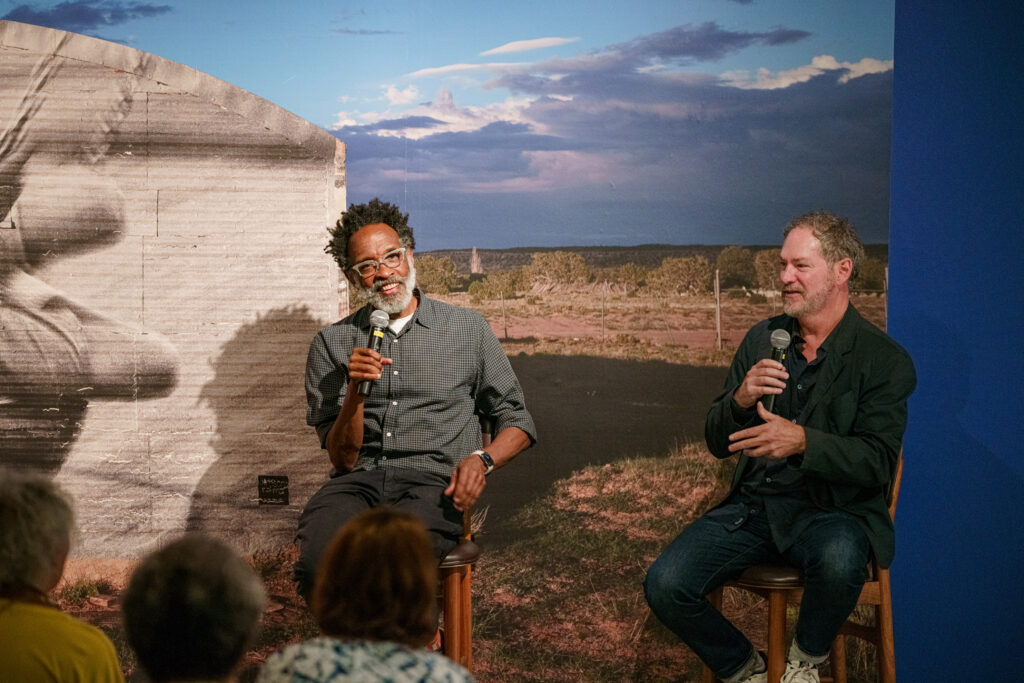
FotoFocus is proud to have collaborated on Chip Thomas and the Painted Desert Project at the Contemporary Arts Center and a commissioned portrait mural of artist William Rankins, Jr. in Cincinnati. Read an essay written by Kevin Moore, FotoFocus Artistic Director and Curator, on Thomas’ public murals below.
Chip Thomas’ Public Murals Emphasize the Power of Impermanence
By Kevin Moore
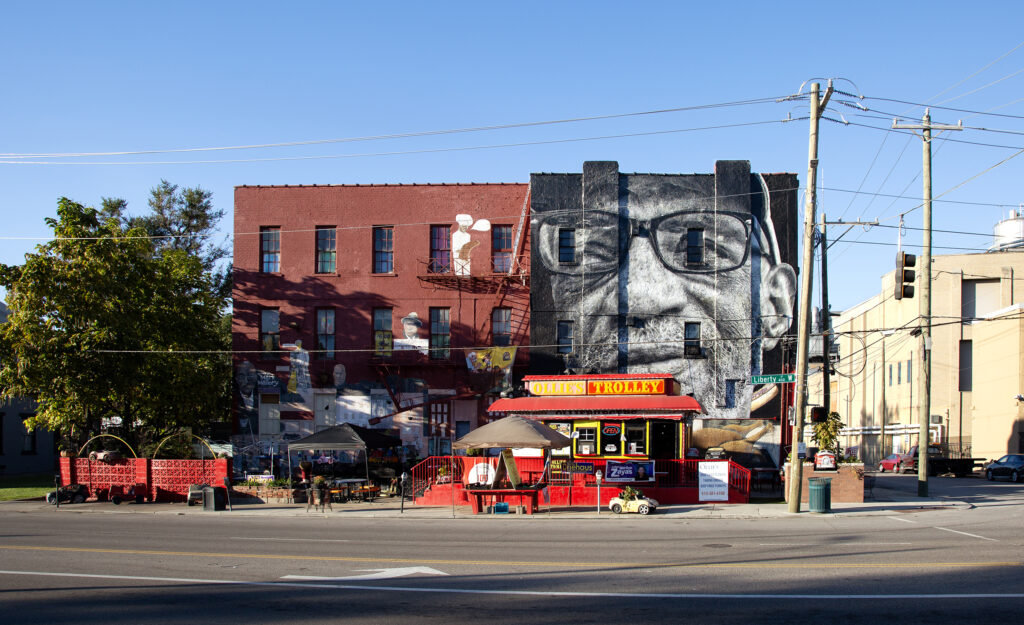
A mural the size of an Easter Island Moai overlooks the intersection of Liberty and Central Parkway in Cincinnati. The mural depicts a bespectacled man by the name of William Rankins, Jr. Based on a black-and-white photograph, the image of Rankins’ head fills almost the entire span of the approximately thirty by forty-foot facade. Rankins had been a muralist in his own day, a painter, whose works adorned many West Side buildings in the predominantly Black enclave of Cincinnati, until a stroke rendered him blind in 2014. Adding insult to further injury, most of Rankins’ murals have been destroyed, succumbing to the elements and redevelopment. Indeed, beneath this massive wheatpaste depiction of Rankins lies a portrait of Barack Obama, painted by Rankins in 2008, and painted over when the wall needed repair in 2019. Scattered around the edges of Rankins’ visage are the very last remnants of his career: images of local Black leaders, hotdogs, and children float like cupids on the exposed brick facade.
Wheatpaste is a common medium for street artists, just as it is for advertising found on billboards and other urban surfaces. The essential materials—paper and wheatpaste with gel medium—are cheap and therefore impermanent, lasting only two to three years, depending on climate. Besides the evident economic considerations, street artists use wheatpaste as part of a shared visual vocabulary, one that encompasses timely messaging from political proclamation to ego airing to cellphone plans.
The mural of Rankins is a kind of public monument, a celebration of a man whose artwork was once a prominent feature of the neighborhood. As a public work, a wheatpaste mural is divergent from the typical stone or bronze monument, made with materials that suggest permanence. Pasted imagery offers a more ad hoc commentary that is fundamentally ephemeral, current, and counter-cultural. Facing off against a $300 million soccer stadium and rampant corporate redevelopment, the fate of the Rankins mural is indeterminate, as is the nineteenth-century building it is pasted on. But there is intention, and investment, in the indeterminacy.
Chip Thomas, who goes by the street artist name jetsonorama, is the artist responsible for Rankins’ portrait. He works in many mediums, but wheatpaste has been a staple since he began pasting in 2009. A physician by profession, Thomas took a job on a Navajo (Diné) reservation in Northern Arizona in 1987 and wound up working there for more than thirty years. Starting with a billboard intervention targeting a Pepsi sign hocking sugary drinks to the diabetes-prone Navajo (in the early morning hours, Thomas and a colleague changed “Welcome to Pepsi Country” to “Welcome to Diabetes Country”), Thomas soon began pasting blown-up versions of his own photographs on structures scattered across the desert. His subject matter has been the Navajo themselves. Much like the French street artist JR (whom Thomas cites as an influence), Thomas has found a positive approach to expressing both the struggles and the inherent beauty of the native people he has lived among for so many years.
At the heart of Thomas’ practice—both medical and artistic—is a notion of care: care for oneself, the environment, and the cultures that sustain us. His objective has been to help patients “find a state of wellness,” both inside the clinic and on the reservation where they live. This has involved getting into the mindset of the Navajo. Thomas likes to tell the story of a toddler named Adrienne he once examined for seizures. In addition to his proscribed Western medical treatment, the family arranged for a medicine man (háátali in Diné, or singer, because prayers are sung) to perform a traditional sand-painting ceremony, which entailed seating the child in the center of an elaborate sand painting that had taken all night to create, patting her with a mixture of herbs, and singing a prayer. As Thomas looked on, the fidgety child began playing in the sand, destroying its patterns, and within minutes the ceremony was over.
Twenty-one years later, Thomas was going through a particularly difficult period in his life and pasted a mural of a Navajo girl, her head thrown back in laughter, on the side of a house in the desert, to be “reminded of joy and beauty in the world.” As the months passed, horses ate at the mural’s edges and it began to fray. Thomas decided to replace it with a more durable version in acrylic gel medium. Not long after, Thomas observed that the house itself was being dismantled; the family had had an ownership dispute and was resolving the issue by tearing it down. In that moment, something clicked. Thomas remembered Adrienne and the sand-painting ceremony, and thought: the medicine man had invested his time in making the sand painting with prayers and good intention, and then let it all go. Thomas’ own ephemeral art practice was similar, a finite action invested “with love and good intention,” and then let go.
Asked recently about the idea of permanence, Sunny Dooley, a Navajo storyteller and friend of Thomas, spoke poetically about the “long view,” praising such permanent entities as ancient places, rock etchings, solstices, equinoxes, weather patterns, and the language of ancestors, while brushing aside momentary concerns, such as property, governance, petty disputes. Living under the oppression of the US government for over a century, the Navajo have seen much of their culture destroyed, yet maintain a defiant dignity in remembering the essential elements of their past. “There is no beginning time or end time,” she explained. “Longer living history continues.”
Thomas’ mural of Rankins is an audacious monument to defiant dignity—to longer living history. For not only is the medium ephemeral, so is the building it is on. Towering above Ollie’s Trolley, a beloved soul-food diner established by local businessman Marvin Smith in 1993, the building interior also houses what remains of Rankins’ oeuvre—paintings and drawings of Martin Luther and Coretta Scott King, mountain landscapes, musicians, and characters from The Wizard of Oz fill three floors. Smith, an old friend of Rankins, has housed the works in the building for decades. Rankins had even lived there at one time.
Smith has felt ambivalence about the rampant development of the neighborhood and admits that he has considered offers to sell. Yet he remains, mostly for sentimental reasons, and because he doesn’t want to let down the community that has supported his business over the years. “Some people got real fiery with me,” he says. “You’re a sellout; you’re gonna let them people come in here and buy your property and we’re not gonna have no place to go.’” Smith recognizes that Ollie’s is a gateway to the neighborhood’s past. “I gotta listen to all that, because it means a lot to me, what people think about Ollie’s Trolley.”
The recent mural of Rankins is a further investment in the site, its history, the old neighborhood—an investment made with love and good intention. Among the project’s cohort, the mural has come to symbolize more than a memorial to a threatened neighborhood but a willful act of defiance against the forces of change. Thomas, who titled the mural Sight ≠ Vision, drew inspiration from a maxim Rankins often repeats: “I walk by faith now, not by sight.” Thomas strategically aligned the eyes of his subject over the building’s windows, invoking the idea of the eyes as a window to the soul, an old photography cliché. But here the metaphor extends further, suggesting an interior vision, one of memory, an insistent recognition of the value of a neighborhood and friendships still flourishing.

Another cliché about photography is that it is a medium that preserves. “Kodak moments: the memories you can keep forever,” goes the old corporate slogan. But the memories are only as permanent as the paper they are printed on. And memories require people to remember. If Ollie’s Trolley is demolished, who at the intersection of Liberty and Central Parkway will remember Rankins’ murals, the diner, and the bonds that were formed there? Who will preserve “the ancient places, the rock etchings, the language of ancestors” against the short-term money investors, speculators, and developers? Surely, people, their creativity, friendships, and memories are more precious.
We are living in hot economic and political times. While many predictably capitalize on the instability, rushing impulsively toward perceived opportunities with no concern for others, the environment, or democracy itself, some take a more thoughtful approach. In a Christmas Eve social media post, Rebecca Solnit ruminated on the “ugly era” coming. Taking the long view, she wrote: “It’s an era; it will end; it will do as much damage as it can but seek to perpetuate itself; it may be that we can end it and hasten its end; all I know for sure is that a lot depends on us.”
Cold comfort, perhaps, to imagine that everything is impermanent—eras, institutions, governments. And that goes equally for beloved diners, murals, sand paintings, and friendships. But there can be purpose in ritualized acts of hope. The challenge we face is not so much to preserve that which is impermanent, but to invest our daily work, whatever that may be, with love and good intention. To constantly make those fine distinctions between what is ultimately good and bad, generous or selfish, creative or sterile, so that ultimately the greater human values of love, dignity, sociability, and creativity can flourish.
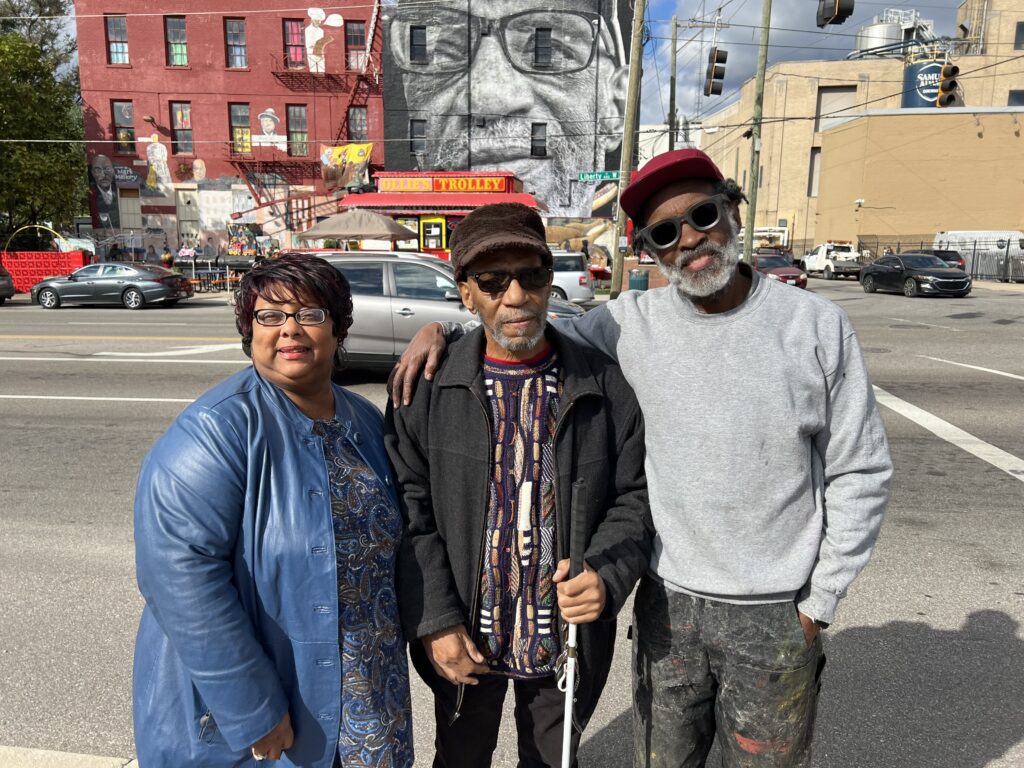
On October 15th, 2024, an informal unveiling for the mural was held. Gathered that day were Rankins, his friend and social worker Deb Clinkscale, along with Smith, Thomas, and members of the community. Describing the mural to the sightless Rankins, who was still trying to wrap his head around the enormous effigy he could not actually see, Smith proclaimed, “Your heart and soul are in this building!” Humbled, Rankins replied quietly, “I was always doing it for a reason.” While the fate of Rankins’ legacy remains uncertain, along with the fate of Ollie’s Trolley and the old West End neighborhood, the prayers have been offered with love and good intention. And with an exhale, letting it all go, we can only continue to hope.
Sight ≠ Vision is part of the exhibition Chip Thomas and the Painted Desert Project, curated by Kevin Moore as part of the 2024 FotoFocus Biennial, which closed at the Contemporary Arts Center, Cincinnati, on January 5, 2025.
ABOUT CHIP THOMAS
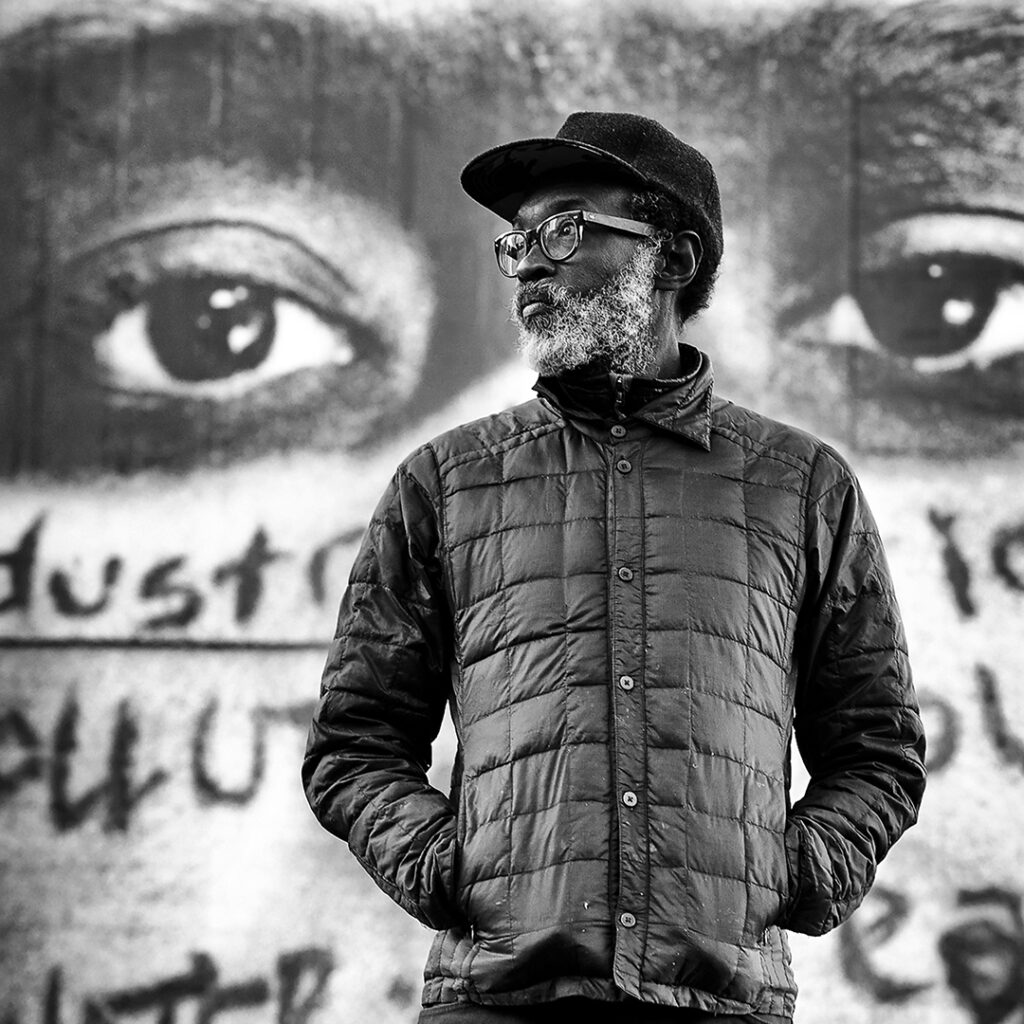
Chip Thomas, a.k.a. jetsonorama, is a photographer, street artist, and physician who has been working in a small clinic on the Navajo Nation since 1987. There he coordinates the Painted Desert Project, a community-building dialogue which manifests as a constellation of murals painted by artists from the Navajo Nation and around the world.
Thomas’ public artwork consists of enlarged black and white photographs pasted onto structures along roadsides across the country, but primarily on the Navajo Nation. Thomas was a 2018 Kindle Project gift recipient and, in 2020, was one of a handful of artists chosen by the United Nations (UN) to recognize the 75th anniversary of the UN’s founding. With no formal artistic training, he identifies strongly with the DIY energy of punk and hip-hop.