Featured Exhibition Highlight: Paul Mpagi Sepuya: Compressed Tenses
Posted on October 2, 2026
One of six Featured Exhibitions in the 2026 Biennial, Paul Mpagi Sepuya: Compressed Tenses is curated by Michael Goodson, Director of the Alice F. and Harris K. Weston Art Gallery. This exhibition is on view beginning October 2 with an Opening Reception at 6pm. Additionally, Sepuya will be in conversation with Carmen Winant, Artist and Roy Lichtenstein Chair of Studio Art at the Ohio State University, on Saturday, October 3 at 2pm. These events are open to anyone with the free Biennial Pass.
To introduce the exhibition, Goodson writes the following:
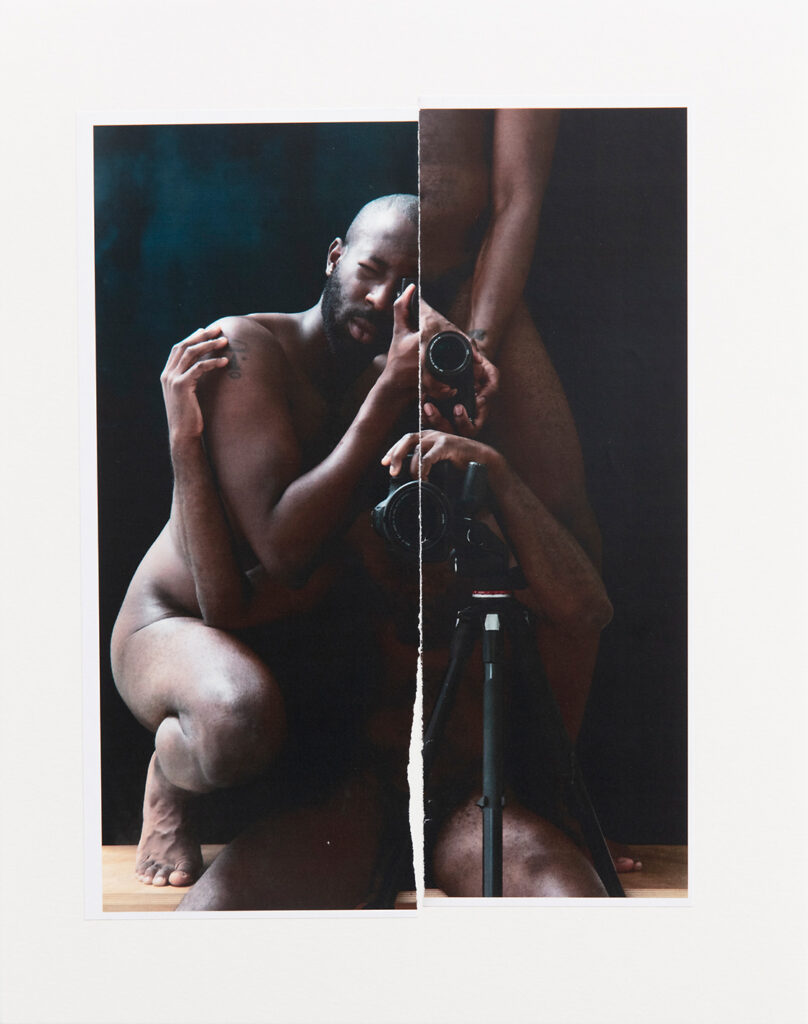
Paul Mpagi Sepuya’s work challenges something fundamental in how we have come to think about photography. While studio portraiture is at the foundation of his work, he does not engage the studio as a space dedicated to illusion—perfectly lit portraits of carefully composed sitters. He has questioned these conventions through a vocabulary of fragmentation, layering, and mirror imagery that reveals the different elements involved, from the physical set-up of a photograph to the social dynamics at play. In effect, he has questioned the camera as an aestheticizing tool and embraced it as a means to complicate its subject. In doing this, his work becomes a deeply questioning exploration of the history of photography.
Sepuya’s work is grounded in the studio as a site through which people, objects, and experiences are both positioned and displaced. Beginning with work made in his Brooklyn apartment, photographs of friends, artists, collaborators, and himself depict presence and absence at once. With the artist’s move to Los Angeles, the studio became a consistent site of increasingly complex ideas. Sepuya’s experiments with mirrors are especially formative, finding that slight optical shifts can radically alter the dynamics of a portrait or a scene. In these images, he allows glimpses of the studio setting and reveals the apparatuses of photography, including backdrops, lighting, lenses, and the camera itself. Although little is hidden, much is obscured, with narratives left to conjecture.
All of these compositions are constructed through analog techniques, with no digital manipulation. In contrast to the artifice of most traditional portraiture, Sepuya points to the human element of picture taking—embracing fingerprints, smudges, and dust on a mirror’s surface to make both his images more tactile.
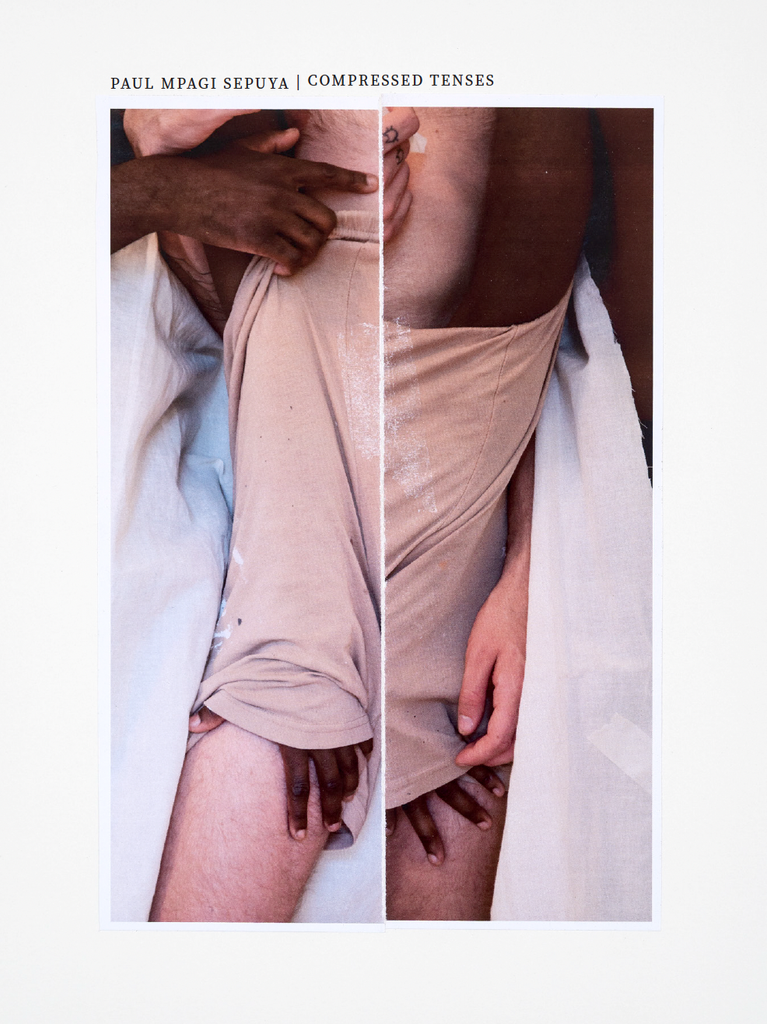
Sepuya’s collages emanate from this tactility. While they are not studies for his larger photography practice, they are linked to this work through ideas around place, sitter, and context. The collages also find their affiliation with the larger practice through touch, a vital component of his work. Touch is often captured in the images not only in the sitter’s physical connections but also in the palimpsest of marks on the mirrors used to make these images.
This haptic aspect also manifests in the making of the collages. Laser prints from the enormous surplus of residual images that come from the studio practice are touched. They are torn, taped, jostled, overlayed, and moved into aching close proximity, physically juxtaposing one moment in time with another.
The exhibition Compressed Tenses (the title is taken from Brian O’Doherty’s collection of essays, Studio and Cube) explores this ancillary and ongoing practice of physical collage in Sepuya’s work. Often constructed while participating in residencies or traveling, his collages are in direct conversation with his other photographic studio work. Like the entirety of his practice, the collages encapsulate a multi-layered investigation of various histories: the gaze, otherness, relationships, queerness and, of course, photography itself.
What is a Studio?
By Carmen Winant

Paul is a studio artist. By which I mean not only that he makes photographs in his studio, but that his studio—as a set, a stage, a subject—is a character in those pictures.
In anticipation of this writing, Paul shares an essay with me, Studio and Cube: On the Relationship Between Where Art is Made by Brian O’Doherty (the text from which his show title draws its name). In it, I read about Lucas Samaras transposing his studio into his solo exhibition at the Green Gallery in 1964. Samaras recreated his workspace, filling it with opened books, a dirty daybed, artworks in progress, discarded underwear—describing it as “a complete picture of me without my psychical presence.” Later in his essay, O’Doherty cites the painter Lowell Nesbitt. Nesbitt says that studio represents “the artists without their faces and bodies.”[1] I think another word for this is a soul.
Is the reader aware that many MFA programs still do not offer studio space to photography students? As if studios were the domain of painters and sculptors alone? As if photographers don’t also need to bring their bodies into contact with their work—their prints, their props? As if darkrooms or desktops are surface area enough? As if they didn’t also require a physical space to imagine, experiment, flail, evolve? As if photographs aren’t material objects in need of a ground?
I do a lot of studio visits; I imagine Paul does too. We are both teachers in public universities who work with graduate students. We both are periodically invited to travel to other institutions—these invitations include meeting with their MFA’s. I’ve been in perhaps a hundred different studios across the country in the last eight years. This never ceases to be a vulnerable exercise. I tiptoe into each space, acknowledging the strangeness my presence. It’s a mutually generous, sometimes halting, act—talking to one another about our developing work, in the place that it happens—but also an invasive one, penetrating. The studio, in other words, is a place for shared inquiry, never (ever) displays of domination.
In Paul’s pictures, the studio is a set for becoming. While my own work looks very different, we share certain commitments: treating the studio as a rehearsal space, exposing its sometimes-disorderly processes in the work. It took me years of working as an artist to gather the courage to show my artwork as I made it in the studio: to maintain its rough edges, its hand-touched-ness. When I see the oil from Paul’s fingers smudged on the surface of the mirror that he photographs into, I feel relief.
Paul works with models in the studio, as artists have done for centuries. Although “models” doesn’t quite feel like the right word; they seem instead to be lovers, friends, doubles. Paul always names his subjects whenever speaking about his work: Anthony, Evan, Darren, Ryan, T.M., Steiner. Model feels too formal a word for this kind of relation, too transactional, too laden with lopsided power dynamics. Perhaps a better word would be muse. I am reminded of JEB (Joan E. Biren) the great lesbian photographer, describing her pictures as “collaborations” in her essay “Lesbian Photography—Seeing through Our Own Eyes”, writing: “This … extends into something reciprocal, mutual, an exchange of inspirational energy.” Decades later, she follows, “I believe that the energy that is exchanged between the photographer and their muse becomes transformed into the image, and later the image radiates that same energy.”[2]
I have never been to Paul’s studio in LA. But I have reconstructed in my head, pieced together a three-dimensional space from his bodies of work. I know its colors, its ceiling heights, the feel of the drywall, the mirrored surfaces on wheels. Paul emails me: “I’m curious to know what you think of that now-old studio from photos. I feel like people have a relationship to it like they do to set/fake homes in television shows.” I think he’s right—it feels like a place I’ve never been but know intimately from the pictures. I imagine Paul there, wheeling his mirror(s) around, changing the lights, talking with his muses and laughing.
In “The Oppositional Gaze: Black Female Spectators” from her book Black Looks: Race and Representation, bell hooks writes that looking back at the camera—meeting its gaze and watching the viewer in turn—can be a form of critical resistance. Inside of a system of “looking relations” that denies complex humanity to some, Black looking (especially engaged by Black women and queer people) is oppositional. hooks understanding this look back as a confrontational refusal to accept mainstream representation, which only knows how to cast the gaze. “Not only will I stare,” writes hooks, “I want my look to change reality.”[3]
Because Paul often does not include the edges of his mirrors into which he directly photographs in the studio, I am made to feel that his pictorial space is endless. Because I can only infer the reflective surface, my logical reasoning begins to slip. As Paul points his camera directly at me, the viewer, I become his subject and his reflection. I’m reminded of Hilton Als’ 2013 book White Girls, in which he refers to his muses—romantic, platonic, and familial—as his twins.[4]
I don’t want to idealize the studio. I don’t want dress it up, romanticize it, or fetishize it as the site of private and unfettered genius. Working in the studio can feel transcendent. But it can also be a slog. Sometimes I go on long walks with the dog in the park or invent many emails that need writing so I can avoid it. Paul, do you ever slink from entering the studio, knowing what it will take to find momentum them?
The studio is conditioned by creativity. It also requires money (which takes time) and time (which costs money). I’ve known artists who work round the clock at restaurant and childcare jobs to pay for a studio they almost never go to owing to the demands of those same jobs. But they know they have it. They know it’s waiting for them, and that is very important. If you keep your engine running, your car won’t stall. I think of Paul’s early portraits of his friends and roommates, which he made at night in his apartment using strobe lighting because he and all his friends worked day jobs.
As I write, Paul is in the process of moving out of this studio, the space he’s occupied for ten years and made so many pictures inside of. It got too difficult to maintain—it’s too far away from his house, his teaching job. He has another space lined up. The new studio is five minutes away from where Paul lives in Los Angeles, but half the size. I wonder how that studio (its newness, its closeness, its spatial limitations) will shape the work that happens there.
I write down these words when first seeing the checklist: quiet, studied, charged, economical, alluring. The collages are full of tenderness and restraint. While I often work by bringing together many disparate parts into a single composition, Paul often brings a single photograph—or perhaps two, uncannily similar images—back together into a partial whole. The dividing slice is almost always a vertical seam, creating latitudinal hemispheres, as if he was holding up the sheet to rip it downwards, along the grain. (The edge is at once even and soft, calling to mind the process of folding a piece of paper and wetting its edge as to hand-rip it.) Sometimes they meet again to have lost a slight middle, other times they appear in reverse order, ever so slightly off-register.
Paul’s collages also have a relationship to the studio: they are made from its overflow, and its absence. Strictly speaking, Paul makes pictures in, and using, the studio. So, what to do when he was away from it—during long stretches of Covid, or working in remote, island residencies? He began to experiment with these test and leftover prints, which would previously have been trashed. These are the “excess,” Paul writes me, “material from organizing, reviewing, testing, editing, sequencing.” He’s made hundreds of collages in the past year alone. They offer a way for him to think, gather information about his practice, and to build new resonant possibilities.
I had the sense, from emailing with Paul, that the pictures happened within of the studio, and the collages strictly without. But, toward the end of this process, Paul gently corrects me, saying that he does sometimes make collages in the studio. The procedural split lies elsewhere: Paul never works on building collages while he’s also in the process of photographing. “The collages end up obscuring the studio in some way … I have to set aside photographing [to make them],” he writes. That seems a telling detail, and one I can relate to (the studio can hold a lot, but in turns of season). This whole time I have been writing about what the studio can tell us about the practice of the artist inside of it. Maybe it is the other way around, in the end: what the rhythms of the artist can reveal to us about the aptitude of the studio.
[1] Brian O’Doherty. Studio and Cube: On the Relationship Between Where Art Is Made and Where Art Is Displayed. New York: Temple Hoyne Buell Center for the Study of American Architecture, 2007.
[2] Joan E. Biren. Interview by Kerry Manders. “WOMEN TALK: JEB.” Women Photograph. August 9, 2019. https://www.womenphotograph.com/news/2019/8/6/women-talk-joan-e-biren.
[3] bell hooks. Black Looks: Race and Representation. Boston: South End Press, 1992.
[4] Hilton Als. White Girls. San Francisco: McSweeney’s, 2013
From the Archives
Carmen Winant joined FotoFocus in 2017 for a panel entitled Woman with a Camera, at the Second Century: Photography, Feminism, Politics Symposium. Watch the full panel discussion below.